
Which Frozen Character Are You?
Which Frozen Character Are You?
Learn More About Frozen
Frozen arrived in November 2013 and proceeded to eat the culture whole. It became the highest-grossing animated film in history at the time, won Academy Awards for Best Animated Feature and Best Original Song, spawned a Broadway musical, a blockbuster sequel, and a level of playground saturation that parents of that era still describe with a particular haunted expression. More than a decade on, a third film is in development and the franchise shows no real sign of cooling.
The film is loosely, very loosely, adapted from Hans Christian Andersen's The Snow Queen, a story Disney had been trying and failing to crack since Walt himself looked at it in the late 1930s. The breakthrough came when the writers stopped treating the Snow Queen as a villain. Once Elsa became a frightened sister rather than an antagonist, and once the central relationship became two siblings rather than a romance, the whole thing clicked into place.
That structural choice is why the movie landed as hard as it did. Elsa is born with power she cannot control, is taught by well-meaning parents to suppress and hide it, and spends her adolescence terrified of her own nature. Anna, shut out without ever being told why, grows up lonely and relentlessly hopeful. The act of true love that breaks the curse is not a kiss but Anna throwing herself between her sister and a sword. For a studio whose reputation was built on romantic rescue, that was a deliberate correction.
Then there is Let It Go. Written by Kristen Anderson-Lopez and Robert Lopez and performed by Idina Menzel, the song was originally conceived for a villain and ended up reshaping the entire film around itself. The production team has said openly that once they had it, they had to rewrite Elsa's earlier scenes to make the character match the song. It has since been read as an anthem of self-acceptance by an enormous range of audiences, including a substantial queer readership that the filmmakers have acknowledged with warmth.
The supporting cast earns its keep. Olaf, a snowman who dreams of summer without understanding what summer would do to him, is a joke that becomes quietly poignant on rewatch. Kristoff is a refreshingly unglamorous love interest whose closest relationship is with a reindeer. Hans is the franchise's sharpest trick, a prince who performs every beat of the standard Disney suitor until the moment he stops.
Frozen II in 2019 went somewhere genuinely stranger, digging into the origins of Elsa's magic, the history of Arendelle's treatment of the Northuldra people, and a reckoning with inherited wrongdoing. It is darker, less tidy, and more ambitious than the original, and it grossed even more.
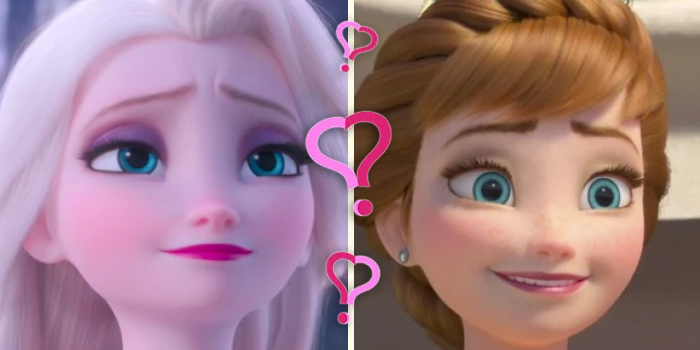
What sustains the franchise is that the two sisters represent opposite and equally recognizable ways of being in the world. Elsa's instinct under pressure is to withdraw and handle it alone. Anna's is to charge forward and trust people, sometimes badly. Most of us lean hard toward one of those and quietly wish we were better at the other.
If Arendelle is your kind of place, try Which Moana Character Are You?, Which Little Mermaid Character Are You?, or Which Encanto Character Are You? next.