
Which Ouran High School Host Club Character Are You?
Which Ouran High School Host Club Character Are You?
Learn More About Ouran High School Host Club
Bisco Hatori's Ouran High School Host Club ran in LaLa magazine from 2002 to 2010, and Bones adapted the first stretch of it into a twenty-six-episode anime in 2006. Nearly twenty years later it remains one of the most recommended entry points into shojo anime, and the reason is straightforward: it is a parody that accidentally became the best version of the thing it was parodying.
The setup is deliberately ridiculous. Haruhi Fujioka is a scholarship student at Ouran Academy, an absurdly elite private school. She stumbles into an unused music room, breaks a vase worth eight million yen, and is conscripted into the Host Club — six wealthy boys who entertain female classmates with tea and flattery — to work off the debt. Because she has short hair and wears a boy's uniform, everyone assumes she is male, and she genuinely does not care enough to correct them.
That indifference is what makes the series work. Haruhi is one of anime's great deadpan protagonists, entirely unimpressed by wealth and largely uninterested in gender as a category. The show uses her flatness as a straight edge to measure everyone else's absurdity against, and it lets her be genuinely pragmatic rather than secretly yearning. Her relationship to the club's performance of romance is closer to anthropology than participation.
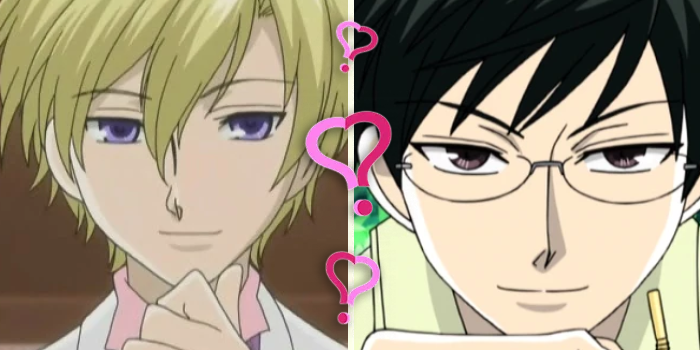
Each host is a shojo archetype pushed until it cracks. Tamaki is the princely type, played as a relentless, sincere idiot with real abandonment issues. Kyoya is the cool intellectual who is actually the club's ruthless business manager. The Hitachiin twins run a forbidden-romance act that the series slowly reveals as a defense mechanism built by two kids who never learned to let anyone else in. Honey is the tiny, cake-obsessed senior who is also a martial arts champion, and Mori is his near-silent cousin. The joke is always the archetype; the substance is always what the archetype is hiding.
What has kept the series alive is how much genuine feeling Hatori smuggled in underneath the comedy. The Hitachiin arc about outgrowing a closed world is legitimately affecting. Tamaki's family situation gets darker than the tone prepares you for. And the show's casual fluidity around gender presentation — never treated as a crisis, never played for cheap laughs at Haruhi's expense — reads as remarkably ahead of its time to audiences discovering it now.
The anime famously covers only a fraction of the manga and ends before the story does, which has fueled two decades of unanswered demand for a second season. Hatori finished the manga in 2010 with a full conclusion, and readers who continue past the anime get considerably more resolution. A Japanese live-action drama and film followed in 2011 and 2012, and the series has remained a steady streaming presence ever since.
If you want more in this vein, try our Kaguya-sama: Love Is War quiz for another comedy about elite students refusing to admit their feelings, Fruits Basket for the shojo classic that goes deepest on found family, or Toilet-Bound Hanako-kun if you want something warmer and more modern.