
Which Bocchi the Rock! Character Are You?
Which Bocchi the Rock! Character Are You?
Learn More About Bocchi the Rock!
On paper, Bocchi the Rock! is another entry in a very familiar genre: a group of high school girls form a band, play some shows, and grow up a little. In practice it is one of the most formally adventurous anime of the last decade, and the reason is its protagonist. Hitori Gotoh, nicknamed Bocchi, has crippling social anxiety, and the series decided that the honest way to depict that was to break its own visual language every time she felt it.
Adapted by CloverWorks from Aki Hamaji four-panel manga, the show swerves without warning into claymation, live-action footage, crude sketch animation, surreal collage and full parody sequences whenever Bocchi internal state overwhelms the frame. She melts into a puddle. She turns into a fungus. She is rendered as a badly drawn stick figure. It should feel like a gimmick and instead it feels like the most accurate depiction of anxiety in mainstream animation, because it captures the specific way panic distorts reality rather than simply narrating it.
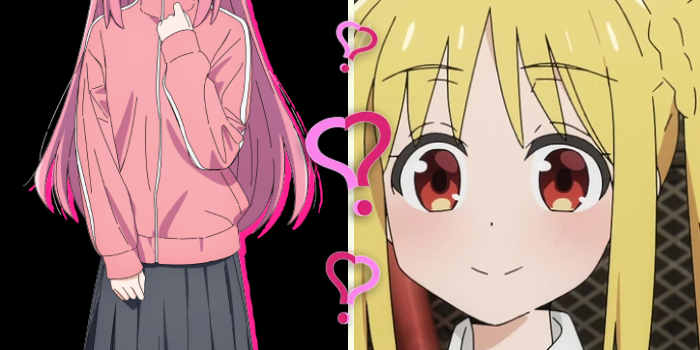
The band around her, Kessoku Band, is built from complementary dysfunctions. Nijika Ijichi, the drummer, is the organizer and social glue, the one who recruited a stranger clutching a guitar case off the street on instinct. Ryo Yamada, the bassist, is coolly detached, has ruinous spending habits and a diet that alarms everyone, and is more emotionally invested than she will admit. Ikuyo Kita, on vocals and rhythm guitar, is the extrovert whose openness gives the group its public face and whose own insecurities take longer to surface. Presiding over the whole operation is Nijika older sister Seika, who runs the STARRY live house and treats the band with brusque, unmistakable affection.
The music is genuinely good, which matters more than it sounds. Kessoku Band songs charted in Japan and the tie-in album performed like a real release rather than a merchandising exercise, with lyrics written from Bocchi perspective that read as sincere rather than in-character. That authenticity is a big part of why the fandom around the show has stayed so durable.
What has kept people recommending it, though, is the emotional accuracy. The series never treats Bocchi anxiety as a problem to be solved by the power of friendship. She improves incrementally and inconsistently. She has good days and complete collapses. She gets on stage and then cannot make eye contact for a week. Anyone who has actually lived with social anxiety tends to recognize the rhythm immediately.
Following the television series, the story continued into a set of theatrical releases that recompiled and extended the material, and the franchise has kept expanding on the strength of an audience that treats it less like a show they watched and more like a thing that understood them. It sits comfortably alongside the best of the music-anime tradition while looking and behaving like nothing else in it.
If you want more anime built on character rather than spectacle, try Which Oshi no Ko Character Are You? or Which My Dress-Up Darling Character Are You?. For more school-set stories, there is Which Blue Box Character Are You?, and for something gentler, Which Frieren Character Are You?.