
Which Wicker Character Are You?
Which Wicker Character Are You?
Learn More About Wicker
Few festival premieres generated as much bewildered delight in early 2026 as "Wicker," the romantic fantasy comedy that closed out Sundance with one of the strangest loglines in recent memory: an ostracized fisherwoman in a conservative medieval village, fed up with judgment and loneliness, sarcastically commissions the local basket weaver to build her a husband out of wicker. What follows is, against all odds, a genuine love story, one that upends the entire village's ideas about desire, marriage, and social convention.
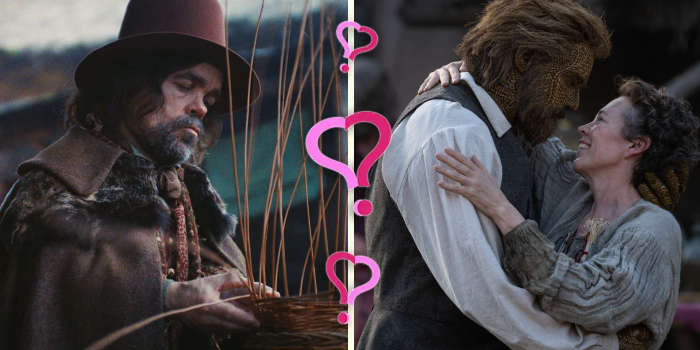
Directors Alex Huston Fischer and Eleanor Wilson adapted the film from Ursula Wills-Jones's short story "The Wicker Husband," and assembled a cast that reads like an awards-season fantasy draft. Olivia Colman plays the Fisherwoman, an outcast whose sharp tongue and refusal to shrink herself for the village's comfort make her instantly magnetic. Peter Dinklage plays the Basket Weaver who takes her half-joking request seriously and, through his craft, brings something unexpected to life. Alexander Skarsgård plays the Wicker Husband himself, a role that required one of the most elaborate practical transformations in recent film history.
Rather than leaning on CGI, "Wicker" turned to Wētā Workshop, the legendary New Zealand effects house behind "The Lord of the Rings" and "Avatar," to build Skarsgård's character as a real, physical suit. Prosthetic Makeup Designer Joe Dunckley led a three-layer construction: a 3D-printed shell molded to Skarsgård's body, genuine hand-woven wicker applied over the surface, and only minimal digital compositing used to make the character appear hollow through the natural gaps in the weave. The result became an instant viral sensation once trailers dropped, with the character's uncanny, handmade look spawning countless memes, including an unexpected IKEA ad riffing on the "wicker man" aesthetic.
The supporting cast deepens the village's social dynamics considerably. Elizabeth Debicki plays the Tailor's Wife, whose composed public persona hides a much messier private reaction to the Fisherwoman's unconventional new romance, while Richard E. Grant plays the Doctor, the village's self-appointed voice of reason and propriety, who has plenty of judgment to spare for everyone except himself.
Critics who caught the film at Sundance in January 2026 praised its willingness to commit fully to its absurd premise while still finding real emotional stakes underneath the comedy. Black Bear picked up the film for a limited theatrical release beginning October 23, expanding nationwide October 30, timing that puts it squarely in the middle of the fall awards conversation as one of the year's most original studio bets. The film is rated R for sexual content, language, and brief nudity, underscoring that despite its fairy-tale premise, "Wicker" is very much an adult fable.
Part of what makes the film linger is how unwilling it is to hand any single character a clean moral high ground, the fairy-tale trappings are really a way of examining ordinary compromises around desire, duty, and self-deception. That refusal to moralize is exactly why critics keep describing it as funnier and sadder than its marketing lets on.
Whether you relate to the Fisherwoman's refusal to settle, the Wicker Husband's strange, soulful sincerity, the Basket Weaver's quiet craftsmanship, the Tailor's Wife's buried longing, or the Doctor's need to diagnose everyone but himself, "Wicker" has a character built for the way you navigate desire and convention. Take the quiz above to find out which one is you.