
Which Cowboy Bebop Character Are You?
Which Cowboy Bebop Character Are You?
Learn More About Cowboy Bebop
Cowboy Bebop aired in Japan in 1998, ran for twenty-six episodes, and has never really gone away. Directed by Shinichiro Watanabe at Sunrise, written largely by Keiko Nobumoto, and scored by Yoko Kanno, it is the rare series where every element was firing at the same level at the same time. It follows the crew of a beaten-up spaceship, the Bebop, working as bounty hunters across a colonized solar system in 2071, mostly failing to make rent, and gradually being caught up by the pasts they each thought they had escaped.
The premise sounds episodic and largely is. Most sessions, as the episodes are called, are self-contained: a bounty, a scheme, a chase, and an ending in which the crew somehow ends up broke again. But threaded through them is Spike Spiegel's history with the Red Dragon crime syndicate, a woman named Julia, and a man named Vicious, and the series tightens that thread very slowly until the final episodes, when it pulls hard.
Yoko Kanno's score is not incidental to the show's reputation. She composed for a full band, the Seatbelts, and moved freely between hard bop, blues, country, gospel, and orchestral pieces depending on what the episode needed. The opening theme, Tank!, is a big-band brass number that announces immediately that this will not be a conventional science fiction series. Watanabe has said he cut episodes to the music as often as the reverse, and the show has the loose, improvisational rhythm of the genre it is named after.
Its aesthetic borrowing is unusually wide. There is Hong Kong action cinema in the fight choreography, film noir in the lighting, spaghetti western in the bounty structure, and Blade Runner in the urban design. Watanabe has been open about all of it. What keeps the show from feeling like pastiche is the melancholy underneath: this is a series about people who cannot move forward, disguised as a series about people constantly in motion.
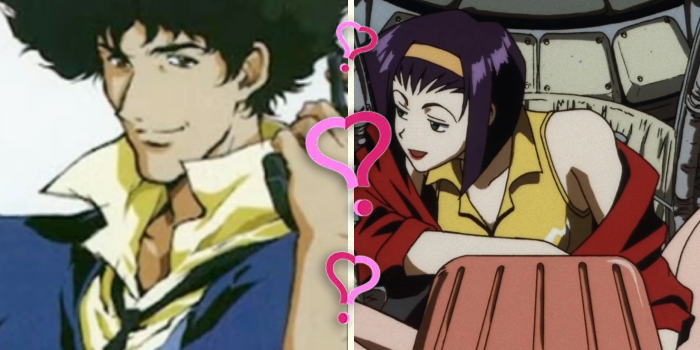
The four crew members are drawn with real economy. Jet Black, a former cop with a prosthetic arm, is the closest thing to an adult on board. Faye Valentine wakes from cryogenic sleep with amnesia and enormous debt and spends the series defending herself against a past she cannot remember. Edward, a teenage hacker of indeterminate everything, joins in the middle and functions as the show's only source of uncomplicated joy. Ein, a genetically engineered corgi, is smarter than most of them and says nothing.
Cowboy Bebop's American history matters too. In 2001 it became the first anime broadcast on Adult Swim, and for an enormous number of Western viewers it was the first anime they ever watched that was aimed squarely at adults. The English dub, with Steven Blum as Spike, is one of the few widely considered to rival the original. A generation of American animation fans traces their interest back to a specific late night on Cartoon Network.
Netflix attempted a live-action remake in 2021 with John Cho as Spike. It was cancelled after one season and is generally regarded as a demonstration of how much of the original depended on timing, framing, and Kanno's music rather than on plot. Watanabe himself, asked about it, was politely unenthusiastic. The 1998 series, meanwhile, continues to appear at or near the top of essentially every all-time anime ranking that gets published.
If you want more anime with weight behind the style, try our Vinland Saga quiz, our Frieren quiz for a different kind of long goodbye, or our Studio Ghibli quiz. Now: the drifter, the gambler, the caretaker, the wild card, or the one who could not let it go?