
Which Carrie Character Are You?
Which Carrie Character Are You?
Learn More About Carrie
Stephen King famously threw the first pages of Carrie in the bin. His wife Tabitha fished them out and told him to keep going, and the novel that resulted in 1974 launched one of the most productive careers in modern publishing. Fifty years later the story has been filmed, staged, sung, and remade repeatedly, and it has never lost its grip because underneath the telekinesis it is a very plain story about a child who is bullied at school and terrorised at home, and what happens when she runs out of room.
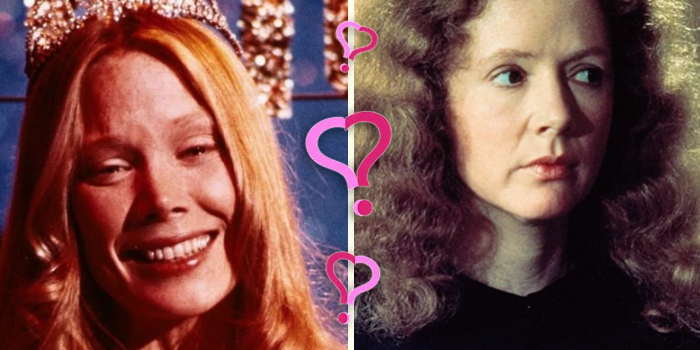
Brian De Palmas 1976 film remains the definitive screen version. Sissy Spacek plays Carrie White with a stillness that makes the final act land like a physical blow, and Piper Laurie turns Margaret White into something far stranger and sadder than a stock religious fanatic. Both actresses were nominated for Academy Awards, which was almost unheard of for horror at the time, and the prom sequence has been quoted, parodied, and homaged so often that it has become part of the shared visual language of the genre.
Now the story is getting its first television adaptation. Mike Flanagan the filmmaker behind The Haunting of Hill House, Midnight Mass, and The Fall of the House of Usher, and already one of the most trusted King adapters working has made an eight-episode Carrie for Prime Video, premiering in October 2026. Summer H. Howell plays Carrie, with Samantha Sloyan as Margaret, Siena Agudong as Sue Snell, Alison Thornton as Chris Hargensen, Amber Midthunder as Miss Desjardin, and Matthew Lillard as Principal Grayle.
The eight-episode format is the interesting bet here. The novel is short and the films are compressed by necessity, which means Carries classmates have always been sketched rather than drawn. A series has room to make Sue Snells guilt into a real arc rather than a plot device, to give Chris Hargensen a psychology instead of a function, and to let Miss Desjardin be a teacher with her own limits rather than a convenient adult. Flanagans previous work suggests he is far more interested in that than in the blood.
What has kept Carrie relevant is that the horror is entirely social. Nothing supernatural causes the cruelty; the powers only determine the scale of the response. The shower scene that opens the story is about a girl being punished for not knowing something nobody taught her, and every adaptation has had to decide how much of that discomfort to sit in. The good ones sit in it a long time.
The other reason it endures is Margaret. She is not a monster from outside the family; she is a mother whose love and whose fear have fused into the same gesture. That is the part audiences argue about most, and the part a longer format can finally do justice to.
If you like your horror character-driven, try Which Crystal Lake Character Are You? or Which American Horror Story: 13 Character Are You? next.