
Which Pirates of the Caribbean Character Are You?
Which Pirates of the Caribbean Character Are You?
Learn More About Pirates of the Caribbean
In 2003 the idea of making a big-budget film out of a Disneyland ride was widely regarded inside the industry as a mistake waiting to happen. Pirate movies had been box office poison for a decade. Cutthroat Island had famously bankrupted a studio. Disney executives reportedly considered pulling the plug during production over Johnny Depp's performance, which nobody had asked for and nobody could categorize. Pirates of the Caribbean: The Curse of the Black Pearl went on to gross over 650 million dollars and earn Depp an Academy Award nomination.
What Gore Verbinski and his cast understood was that the ride was not a plot, it was a tone: cheerfully macabre, slightly drunk, full of skeletons who seemed to be enjoying themselves. The first film reproduces that tone almost exactly. It is a genuinely good adventure movie with real stakes, funny dialogue, and a supernatural curse that is treated with just enough seriousness to matter. Hans Zimmer and Klaus Badelt's score, written under enormous time pressure, became one of the most recognizable pieces of film music of the century.
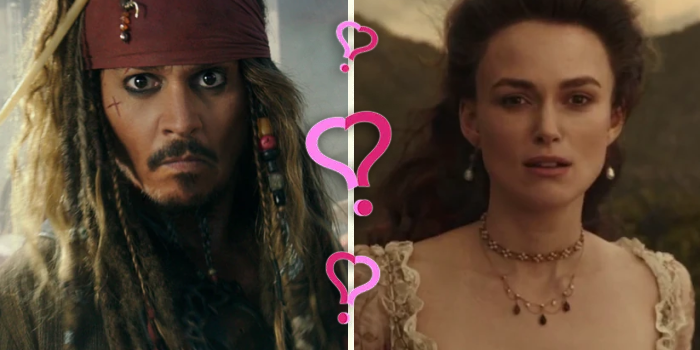
Depp built Captain Jack Sparrow out of Keith Richards and Pepe Le Pew, played him as perpetually unbalanced, and refused to let the studio smooth him out. The character works because he is not actually the protagonist of the first film; Will Turner and Elizabeth Swann are, and Jack is the destabilizing element who keeps knocking their story off course. Orlando Bloom played Will as sincere to the point of exasperation and Keira Knightley took Elizabeth from governor's daughter to pirate lord across three films, giving the trilogy its most complete arc.
Geoffrey Rush's Hector Barbossa is arguably the franchise's most durable creation. Killed at the end of the first film, resurrected for the second, and shifted repeatedly between antagonist and ally, Rush plays him with an actorly relish that never tips into camp. Bill Nighy's Davy Jones, buried under a tentacled motion-capture performance in Dead Man's Chest, is a genuine achievement of both acting and visual effects; the technology developed for his face pushed the field forward measurably.
The sequels grew progressively more baroque. Dead Man's Chest and At World's End were shot back to back and share a plot of considerable density involving the East India Trading Company, nine pirate lords, a sea goddess, and a great deal of double-crossing. Critics were divided; audiences were not, and Dead Man's Chest crossed a billion dollars. On Stranger Tides and Dead Men Tell No Tales followed with diminishing critical returns but continued commercial success. The franchise has grossed over four and a half billion dollars worldwide.
Its cultural footprint is odd and durable. It substantially shaped the modern popular image of pirates, more than any actual history has. It made a theme park ride into a template that studios have chased with mixed results ever since. And the first film in particular has aged into something like a modern classic: a practical-effects adventure movie made just before digital spectacle took over completely, with real ships, real sets, and a cast clearly having a wonderful time.
A sixth film has been in various stages of development for years, with reports alternating between a reboot and a continuation, and Depp's involvement remaining the open question. Whatever happens, the original trilogy has settled into permanent rotation, the sort of thing people rewatch on holidays without quite planning to.
If sprawling adventure ensembles are your thing, try our The Rings of Power quiz, or our Avatar quiz for another world built on spectacle and water. So: the free one, the transformed one, the honest one, the professional, or the one who never got over it?